
Starting Dahlias From Tubers
Thank you!!
If you’ve purchased a dahlia tuber from me, I want to thank you so much for your support of my small business!! I pour so much love, effort and work into my dahlias and I hope that you appreciate the quality of my tubers!
As you kick off the growing season with your dahlias, I wanted to share some helpful tips to get them started successfully! Read on below for my top dahlia growing tips!
Tip 1: Open your package immediately, and get them into a pot with soil.
When you receive your tubers from me, please plan to put them in a pot with soil as soon as possible, ideal timing would be the same day. If you cannot, be sure to keep them in the packaging, nestled in the vermiculite, that I have them in and put them in a cool/cold, but not freezing, dark place. Central Oregon is SO DRY so if you remove them from the packaging and let them sit out without a medium covering them they’ll start to dry out and shrivel. A small amount of wrinkling or softness is nothing to be concerned about, they will be just fine. Best practice: have a pot and soil ready to go.
Tip 2: The soil should be slightly damp, but not super saturated with water. Keep it at this level until you see a green sprout emerge from the soil. The soil should never be bone dry for long periods of time!
This is a mistake I learned the hard way. You will see people say to put your tubers in moist soil and then to not water until you see a sprout. In our VERY DRY environment, I have found that soil that’s moist to start drys out very quickly and super dry soil will not support your tuber’s growth. The soil needs to have a slight moisture to it, and you should choose a pot with good drainage. As a point of reference, I am waking mine up in pots in my greenhouse and I maybe water them very lightly once a week until I see sprouts. I always test the soil by hand before watering. The tuber has most of what it needs to wake up and grow internally within the starchy root. It really doesn’t need much water until it starts growing strong roots and has a sprout. If a tuber is potted in very wet soil or is submerged in water, it will rot.
Tip 3: Place your tuber horizontally with the eye/small sprout facing up in the pot.
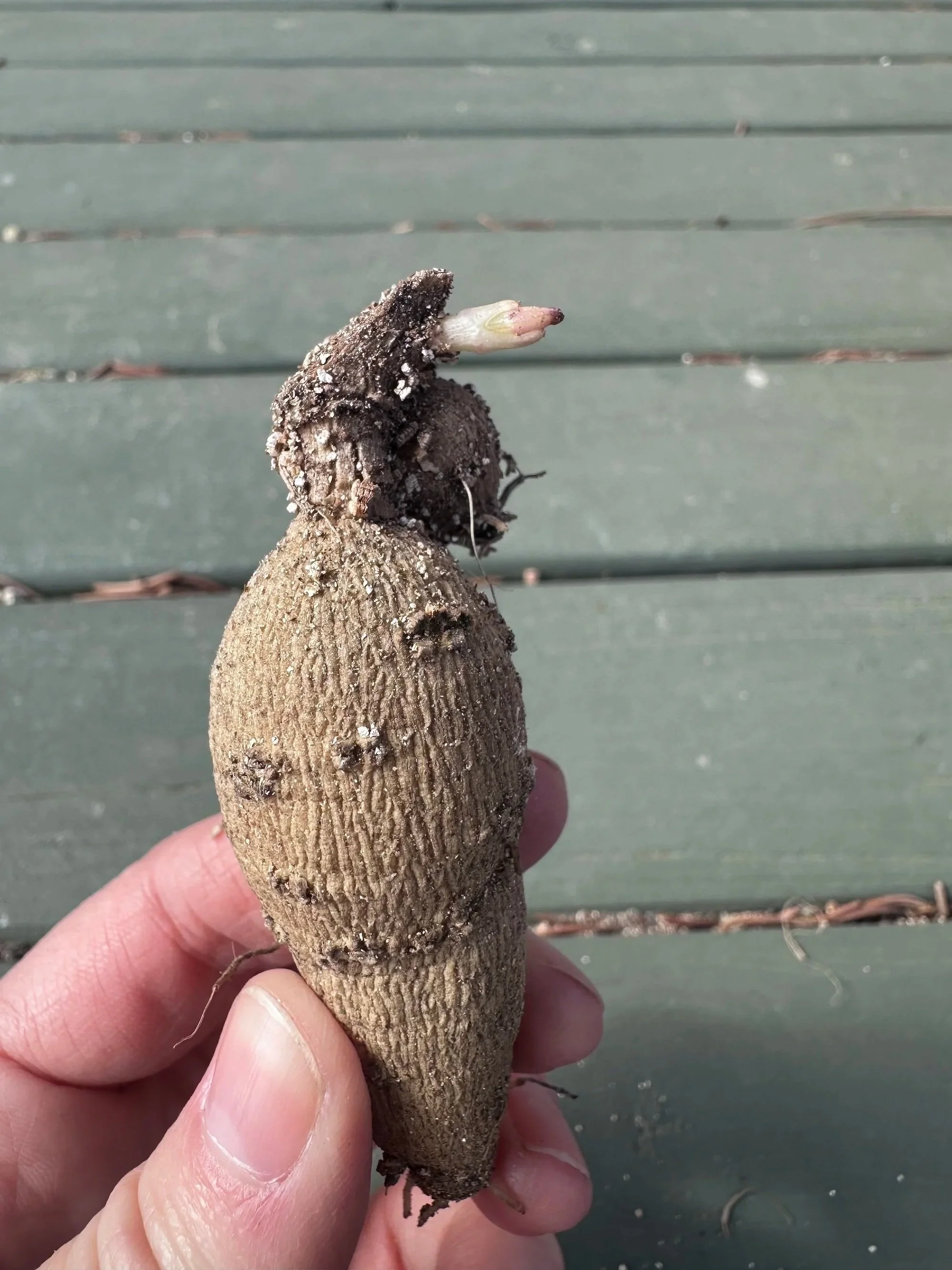
An eye looks like a little green, white/tan, or reddish/purple spot on the crown of the tuber. When they’re small and not sprouted they sometimes has a little bit of a shine to it, which I find is easier to see outside in the sunlight. Rest assured that all tubers I sell have been verified to have an eye many times, and many have sprouted! Your tuber should fit in your pot without touching the edges of the pot. If you need to put it on a slight diagonal to make it fit, go for it, that’s not a problem. The tuber should be about ½ way down the pot, fully covered with your soil. I start all of mine in as small of a pot as possible that fits my tuber size; I start over 200 at once, so I need all the space saving I can get. I do not recommend starting tubers in giant pots. Plan to start smaller and then pot them up into a bigger pot when you have a bigger plant.
If your tuber has a sprout and it’s accidentally knocked off when planting, don’t sweat it. A tuber wants to grow and it will re-sprout from another eye or right next to where the first sprout was. If you have a sprout that gets bent, it can be snipped off at the base (don’t cut the tuber, just the sprout) with clean snips (bleach water works to sterilize snips) and it’ll re-sprout, as well.
Tip 4: Do NOT let your tuber freeze!
Frozen tubers will rot and die. So, you’ll need to get them started in a pot that is easy to move around if needed until you can plant it out or leave it outside this summer. Until the sprout emerges, it doesn’t need much light, so you can get them started in a warmer garage, or a bonus room in your house. Once you see a green sprout, get that little seedling under a grow light or get it sunshine during the day and keep an eye on overnight temps and be prepared to move it indoors overnight if needed.
Tip 5: Choose wisely when to plant your dahlias outside.
Most of Central Oregon is zone 5 or 6, and in reality we can get a frost at anytime throughout the year. I am located on the Eastside of Bend, and plan for the weather to be warm enough to plant out the first two weeks of June - I tend to anchor my annual “planting out” date for tender annuals on Father’s Day. I watch the weather very closely and make a plan from there. This year is trending warmer, so I may plant out sooner, HOWEVER I have hoops and frost cloth on the ready incase there’s a chance of frost. If you’re not planting your dahlias in the ground and can move pots around, this is also an option if you want to have some flexibility.
Frost will not kill your tubers underground (a deep freeze will), but a frost can hurt any green that you have growing above ground.
Tip 6: Growing big, healthy plants.
When you do plant your plant, you’ll want to plant them about 6 inches deep, and spacing should be about 12 inches apart or a little more. Dahlias like it warm with a lot of sunshine. A little bit of shade in the late afternoon or very early morning, or some dappled shade should be fine, just make sure it gets almost-full sun most of the day. Dahlias want their watering schedule to be just right. Too much water you risk rotting the tubers under the soil, and if there’s too little you’ll notice some wilting (which is fixable with a change to your watering schedule). To figure this out, feel the level of moisture in the soil with your own hands and adjust accordingly. Make sure your soil is draining well, so it’s not pooling around the tubers.
I use drip irrigation and highly recommend that if you can. If you hand-water, try to water at the base of the plant instead of spraying the whole thing.
Dahlias love a little fish/seaweed fertilizer as they are getting established. It can be a bit smelly, but I find the Sea Plus Ferilizer from Johnny’s the least offensive on the smelly front. It just kind of smells like a salty ocean to me.
Dahlias are a late-summer/fall blooming plant, so if you get them started this spring, you can expect them to start blooming in late July through our first frost. Once you’re getting to the bloom stage, you can add in a fertilizer that supports blooming (it will be a lower N number in the N-P-K measurement).